
** Originally published on LinkedIn
Modern credit markets have built sophisticated risk models on top of surprisingly weak collateral controls.
The discussion around Market Financial Solutions (MFS) has focused largely on the borrower. But the more interesting question may be about the systems surrounding the loans.
I’ve spent most of my career working on structured finance analytics and asset-based lending infrastructure.
From that perspective, the recent situation involving Market Financial Solutions (MFS) raises a familiar question: how could something like this happen?
A homeowner cannot take out two mortgages on the same house without lenders discovering it. Yet according to public reporting, MFS — which Reuters described as “a little-known UK mortgage provider” — appears to have pledged billions of dollars of loans across multiple financing facilities.
To prevent homeowner fraud, title searches, lien registries, closing agents, and custodians exist specifically to prevent double-pledging. The mortgage market has built infrastructure that makes financing the same house twice extremely difficult.
Yet in parts of modern credit markets, the infrastructure surrounding collateral is surprisingly weak.
The infrastructure needed to prevent this is not particularly complicated.
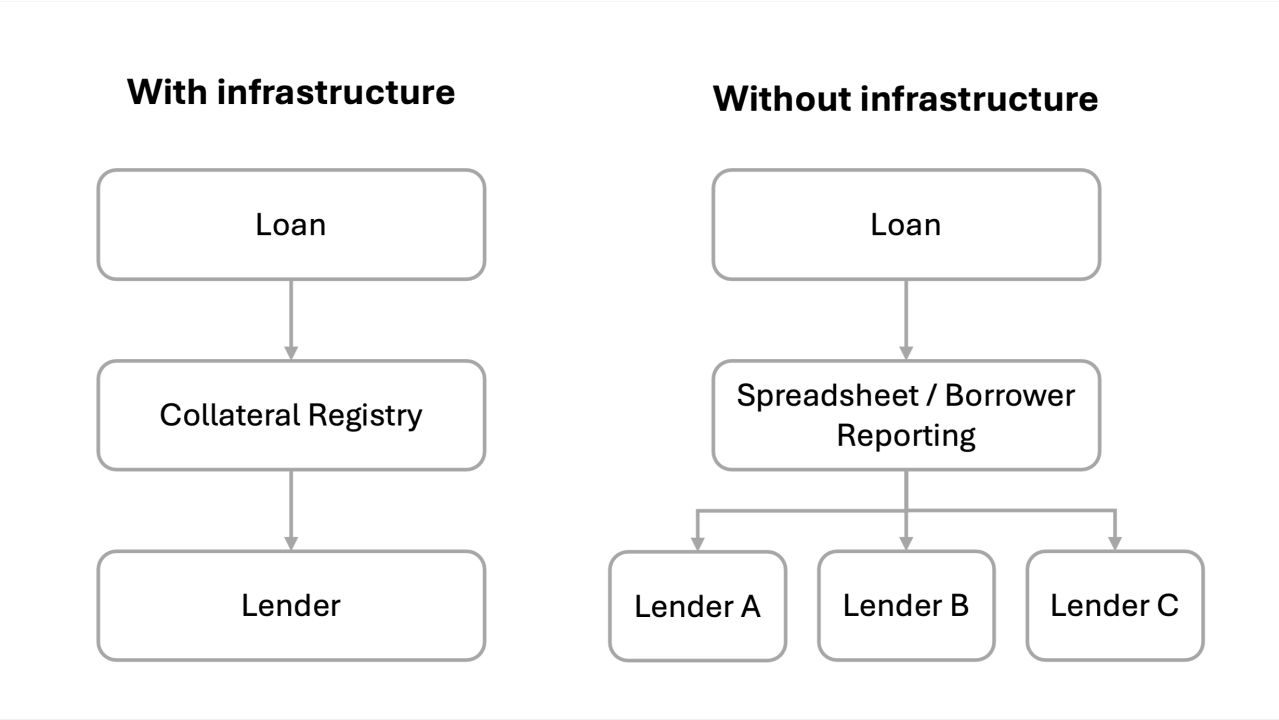
A modern collateral framework would include stable loan identifiers that are independent of the originator’s internal systems, a shared digital registry recording when loans are pledged and to whom, and machine-readable reporting that allows lenders to reconcile collateral continuously rather than through periodic spreadsheet updates.
Capital markets built comparable systems decades ago for securities — CUSIPs, clearing systems, trade repositories. For loans, the equivalent infrastructure largely never appeared.
But technology is only part of the story.
The incentive structure around warehouse lending often reinforces the status quo. Warehouse facilities are originated by individuals whose performance is measured by deal volume, margins, and client relationships. Additional infrastructure — registries, reconciliation systems, independent verification — introduces cost and friction.
The same people who say they want zero risk often resist anything that slows a deal or reduces its profitability.
What makes this notable is that other parts of credit markets have already solved much of this problem.
In U.S. residential mortgages, the protections extend well beyond individual lending. The warehouse and securitization infrastructure surrounding those loans includes multiple independent checks. County lien records establish the mortgage claim on the property. Custodians verify that the loan note and related documents exist and are properly endorsed. Servicers and trustees maintain loan-level records and reconcile balances regularly. Systems such as MERS track servicing and beneficial ownership across much of the market.
The process is far from perfectly digitized, but the combination of registries, custodianship, and standardized reporting makes sustained double-pledging difficult.
Outside that ecosystem, the pattern looks different — and familiar. As widely reported in the financial press, variations of the same problem have appeared repeatedly: Greensill, First Brands, commodity-finance failures such as Hin Leong — where reports indicated that collateral was sometimes pledged multiple times and in some cases did not exist at all — and now MFS.
Each episode exposes the same weakness: lenders ultimately depend on the borrower’s own systems to track collateral. Each time losses occur, the industry revisits the same discussion about infrastructure. And each time the market largely returns to the same practices.
It might seem surprising that the risk functions within these institutions do not stop transactions that rely on borrower-reported collateral. In practice, those functions are structured differently. Credit risk teams focus on the financial characteristics of the deal — loan-to-value ratios, borrower solvency, expected loss under stress scenarios — using the numbers provided by the originator.
The question of whether the collateral exists exactly as reported often falls into the category of operational or fraud risk. Operational risk groups, where they exist, are often smaller, focused primarily on internal controls, or not specialized enough in the underlying asset classes to challenge the structure of the collateral itself. Independent due diligence firms are often engaged to review loan files and underwriting quality, but those reviews typically rely on lender-provided data as well.
Loan tapes arrive as spreadsheets. Borrowing-base calculations are built directly on those tapes. Verification tends to be periodic rather than continuous.
The easiest way for a deal to move forward is to rely on borrower reporting and established market conventions.
None of this means that participants are unaware of the systemic risks. The industry has seen them before. Within individual transactions, people are generally following accepted practices.
But the cumulative effect is a system where known weaknesses persist because addressing them requires collective investment that individual deals have little incentive to bear.
The phrase often used in finance is “trust, but verify.”
In several parts of modern credit markets, the trust remains strong. The verification infrastructure has not evolved at the same pace.
As private credit and warehouse lending continue to expand, the technology required to track collateral reliably already exists.
What has been missing are the incentives to build and adopt it.
Much of the reporting referenced here comes from coverage in Reuters, the Wall Street Journal, and other financial press.