
There is a lively debate about how to build AI agents, the software systems that pursue a goal over many steps on their own, and much of the energy has gone toward more. More agents, each with a specialty, wired together through elaborate frameworks.
So it is worth noticing that some capable practitioners are quietly moving the other way, toward something a software engineer is trained to distrust.
They are building a monolith.
Even the broader move toward harnesses, the scaffolding wrapped around a model to keep it on task, leans this way, back toward one thing rather than many. One approach in this spirit wears its modesty in its name. It is called a Ralph Loop, after Ralph Wiggum, the sweet and hapless child from The Simpsons, and its method is to repeat one small thing over and over, keeping almost nothing in its head and writing everything down instead. The idea comes from Geoffrey Huntley, a well regarded engineer and writer.
His starting point is a limitation anyone who works with these systems will recognize. When agents converse, the record of that conversation grows, and every new instruction carries the whole history along. Today’s models can technically hold an enormous amount at once, often around a million words, but they do not hold it well. As the pile grows, the model gets duller, less careful, more prone to losing the thread. The parallel to ourselves is hard to resist. We too can keep a great deal in mind, and yet the quality of our work slips when we juggle too much. Like us, these models do their best when asked to attend to one small thing at a time.
The approach is disarmingly ordinary. You describe what you want, sketch a rough plan, and then ask the model to take the next step, whatever it judges that step to be. You test the result, update the plan, and do it again. Each round begins fresh, with the work so far, the original description, and the current plan, but not the accumulated transcript of every earlier exchange. The context never swells, and so it never has the chance to rot.
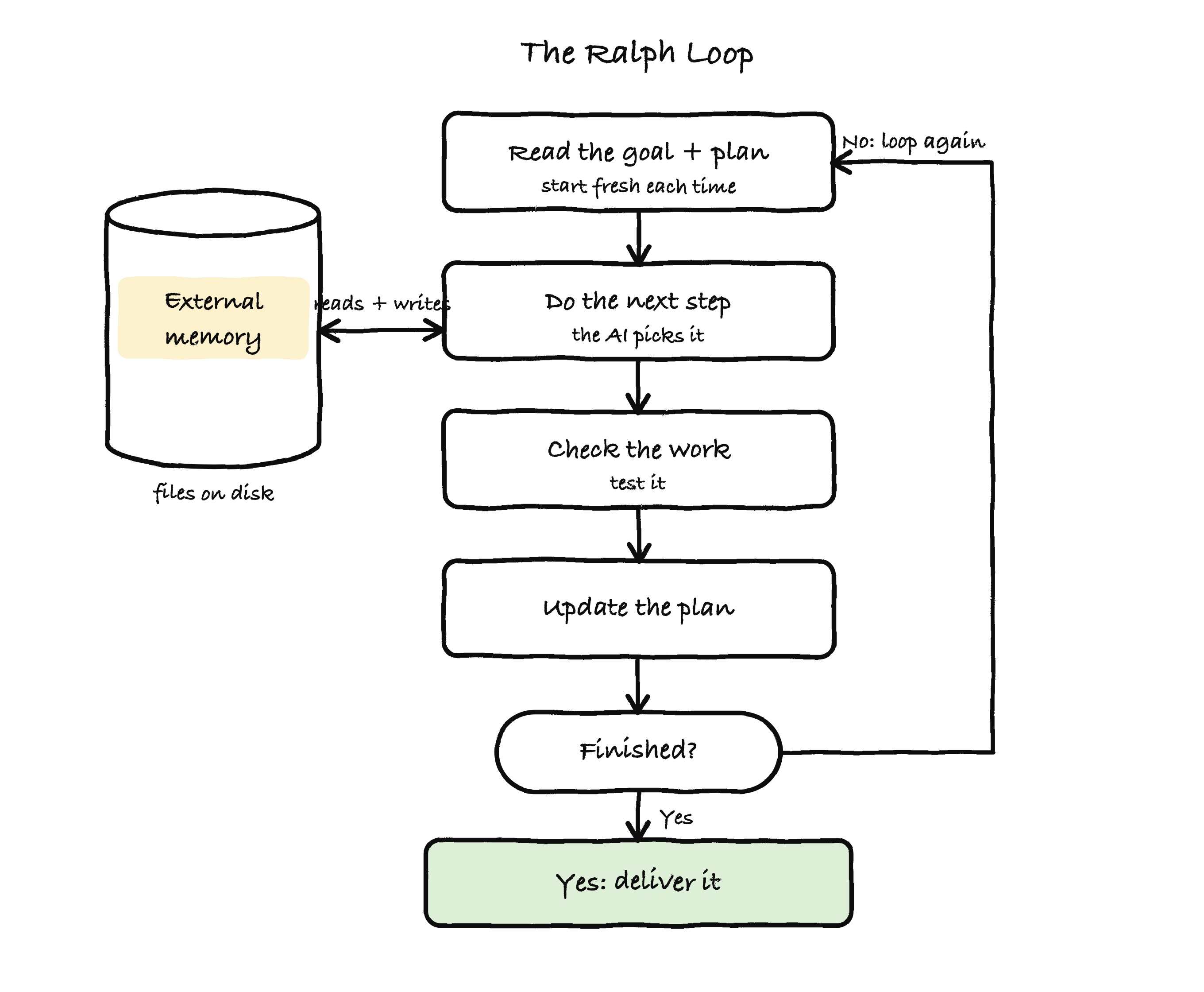
A Ralph Loop runs until, by its own reckoning, the job is done, though an operator can add limits on time or spending. It is genuinely autonomous, choosing each task and how to carry it out, and the mechanism is so slight it fits in ten or twenty lines of ordinary Python, with no frameworks at all.
Which points to something worth holding onto. The most autonomy you can hand to anyone, a team, an employee, or an AI process, is to say simply, this is what I want, and leave the how to them. An elaborate agent system can look like the freer arrangement, full of independent actors each making its own choices. But defining those agents and choreographing how they talk is itself a set of instructions about how the work should be done. The Ralph Loop, for all its plainness, cedes more. It prescribes almost nothing and points everything at the goal.
Its value is not really in question. But that is not the same as saying everything should be goal and nothing else. Where safety, risk, and regulation are at stake, giving a system specific guidance on how to proceed is not a failure of nerve. Sometimes it is the wiser choice.